


Measurement
Beyond the click: Understanding the impact of views on TikTok
Click attribution undervalues TikTok conversions by 73%. Learn more about our holistic measurement frameworks to capture and measure the value of TikTok ad views.

Shoppers are using more devices and platforms than ever, which has made the path to purchase increasingly complex. Understanding which touchpoints are more impactful in driving a purchase is a constant challenge, and historically, marketers have leaned on click-based attribution methods to make sense of this complex user behavior.
Click-based measurement makes more sense in an environment where the user is actively searching for a product and is already one click away from a purchase. However, it severely under-attributes platforms like TikTok where users are immersed in a steady stream of content and engage with brands or discover products while being entertained.
Click-only attribution fails to capture most purchases driven by TikTok
Content on TikTok is highly immersive, so users often delay their visit to a brand's website or app rather than disrupt their browsing experience. And when a user views an ad on TikTok, it's not always a simple click-and-buy scenario. TikTok ad views frequently serve as the starting point for further exploration on other channels.
This multi-channel exploration allows users to gather valuable insights and make informed decisions. They solidify their intent to purchase as they see others enjoying the product, read positive customer reviews, and gain a comprehensive understanding of what they are investing in.
Our research shows that TikTok is a powerful channel for influencing users early in their purchase journey. To better establish the true impact that TikTok views have on performance objectives, researchers from inside and outside of TikTok teamed up for a series of attribution studies. The findings show that:
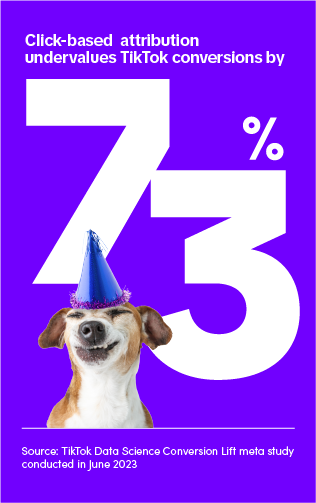
Click attribution undervalues TikTok conversions by 73%
A meta-study carried out across approximately 100 conversion lift tests showed that using a click-only attribution method undervalues TikTok purchases by 73% for app advertisers.¹
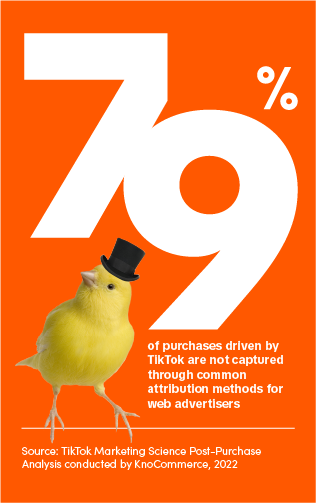
79% of purchases driven by TikTok are not captured through common attribution methods for web advertisers
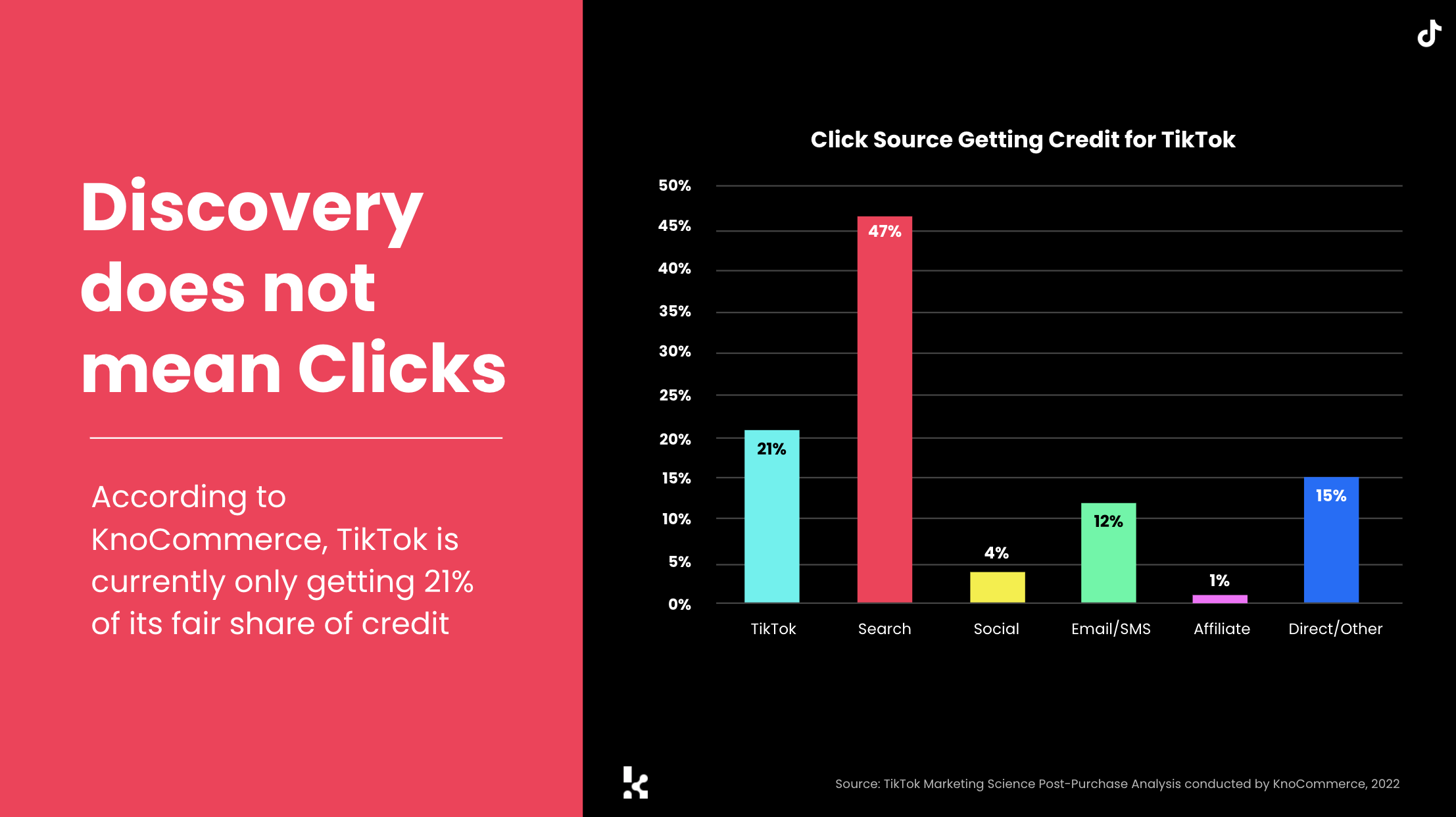
For example, if 100 customers discover a brand on TikTok, only 21 are captured accurately through web analytics tools while 79 are misattributed or not attributed.²
Using click and view-through attribution helps brands exit the learning phase faster
By turning on both view-through and click-through attribution for your TikTok campaigns, you can exit the learning phase up to 113% faster.³ This is in addition to having a lower fluctuation on ad spend, thus increasing performance stability.
Evolving our mobile measurement framework for app advertisers
We recently unveiled new ways for app advertisers to measure attribution beyond last-click models. App advertisers work with mobile measurement partners (MMPs) to understand the actions that users take after an ad is clicked or viewed over a certain period of time. TikTok's recently launched Self-Attributing Network (SAN) is a new MMP network integration that provides advertisers with a comprehensive view of all conversions driven by their TikTok ads beyond MMP's last-touch attribution. This integration offers more campaign performance insights, customized attribution windows, and access to advanced attribution metrics like Engaged View-Through Attribution (EVTA)
Introducing new Measurement Partner specialties
To help brands better understand the impact of advertising on TikTok, the TikTok Marketing Partners Program is proud to announce two new partner specialties in the Measurement Badge category: Cross-Channel and Lift. Paired with TikTok's first-party attribution solution, these partners can help advertisers better understand the customer journey and incremental nature of TikTok campaigns through vetted third-party solutions.
How to capture and measure the value of TikTok ad views
The studies show that traditional attribution methods are undervaluing the impact that TikTok views have on conversions. So, how should advertisers measure the true value of TikTok ad views? The following best practices will set you up for success.
1. Use both click-through and view-through attribution windows
To capture the holistic value driven by TikTok, we recommend leveraging both click-through and view-through attribution windows. TikTok offers 1-day, 7-day, 14-day and 28-day click-through attribution windows, and 1-day, 7-day, and no view-through attribution (VTA off) options.
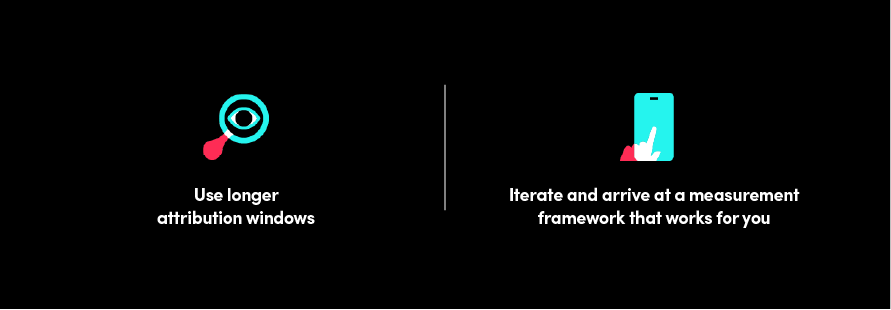
2. Use longer attribution windows
This will help capture more events in your campaign reporting, showing the true impact of your ads. It will also enable faster learning for your ad groups and faster exit from the learning phase, which means a stable CPA and the ability to scale faster.
To compare what your performance would look like under different attribution windows, you can leverage a new feature called Performance Comparison under Attribution Analytics. It will help you understand how many conversions happen at various attribution windows and arrive at a setting that best suits your business objectives.
Our internal research has shown that the optimal view-through window differs greatly by industry (e.g. 16 days for Travel, 19 days for CPG, and 3 days for Gaming).⁴ We currently offer a 7-day maximum view-through window and highly recommend using this option for all campaigns.
3. Give your campaigns sufficient time before making changes
Consider your attribution window when evaluating the success of an ad you are running. For example, if you have a 28-day click window, you may see that your performance improves with time as we capture more attributed events. Making changes to your campaign too often leads to performance fluctuations.
4. Iterate and arrive at a measurement framework that works for you
Getting your media measurement right is an ongoing process, and requires continuous learning, iterating, and refining your strategy. There are several tools and solutions that can help you do this:
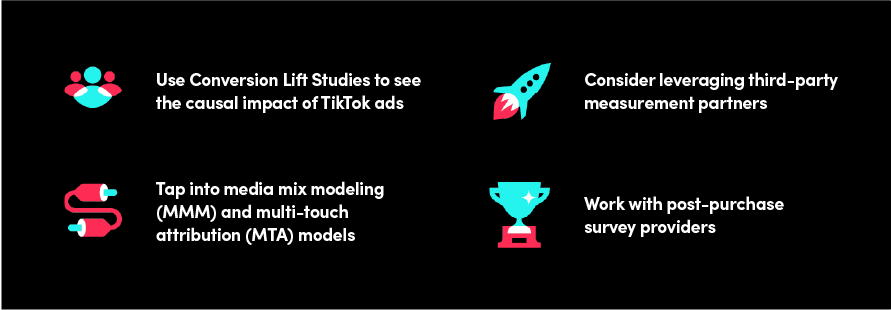
Use conversion lift studies or geo lift studies to calibrate your view-through-attributed conversions. We've talked about how using longer attribution windows helps you capture the maximum number of events in your reporting. You can then conduct incrementality experiments to validate this reporting and calibrate your attribution results.
Tap into media mix modeling (MMM) and statistical multi-touch attribution (MTA) models which include impressions and clicks as inputs in assessing the effectiveness and efficiency of media. These models are different than rule-based attribution models which only rely on clicks.
Leverage Cross-Channel measurement partners like Fospha, Northbeam, Rockerbox and TransUnion (formerly Neustar) and post-purchase survey providers like Fairing and KnoCommerce to determine TikTok's influence on a purchase across touchpoints.
Work with Lift measurement partners like Kantar, Nielsen, LiveRamp, NCS, Foursquare and SambaTV to measure the incremental impact on brand lift, sales lift, store visits and tune-ins.
Moving beyond the click
The customer purchase journey has evolved, and TikTok has become a crucial player in this changing landscape. Its ability to captivate and entertain users, coupled with its role as a starting point for research and exploration, has made it a powerful platform for product discovery and influence.
As marketers adapt to this new reality, understanding the value of an ad view on TikTok becomes essential in crafting effective marketing strategies and accurately measuring the impact of your campaigns. We are committed to helping businesses of all sizes grow on TikTok and would love to partner with you to evolve how you measure your marketing.
*Reach out to your account team and Measurement Partner to learn more
Sources:
1. TikTok Data Science Conversion Lift meta study conducted in June 2023
2. TikTok Marketing Science Post-Purchase Analysis conducted by KnoCommerce, 2022
3. TikTok-AppsFlyer report, Video is on the rise: View-through attribution (VTA) insights for Southeast Asia
4. TikTok Marketing Science Optimal View Through Window Analysis conducted in Jan 2023
TikTok's measurement tools are designed to cover every touchpoint in the customer journey. Visit our measurement solutions page to learn more.
Learn more